What's inside
Food and beverage processing is heat-dominant, fragmented across eight to ten sub-sectors, and under-mapped relative to steel or cement. This report sets out the decarbonization toolkit in operational, not aspirational, terms — connecting plant-level energy data to an emissions baseline, then to a marginal abatement cost (MAC) curve, then to a financing plan that captures every available revenue layer.
Through two worked case studies it shows exactly how operating-cost savings, tax credits, fuel-side credits and carbon-price revenue combine to determine which projects clear an investment committee — and why the order in which levers are deployed matters more than the headline carbon price.
Full contents
- 01State of the Sector
- 02Production Processes & Hotspots
- 03Three Reference Facilities
- 04Decarbonization Solutions (five families)
- 05Why Marginal Abatement Cost Is Not Sufficient
- 06Carbon Markets & the Policy Stack
- 07Case Studies (biogas + heat pumps)
- 08How TerraNova Helps & Conclusions
A sample from inside
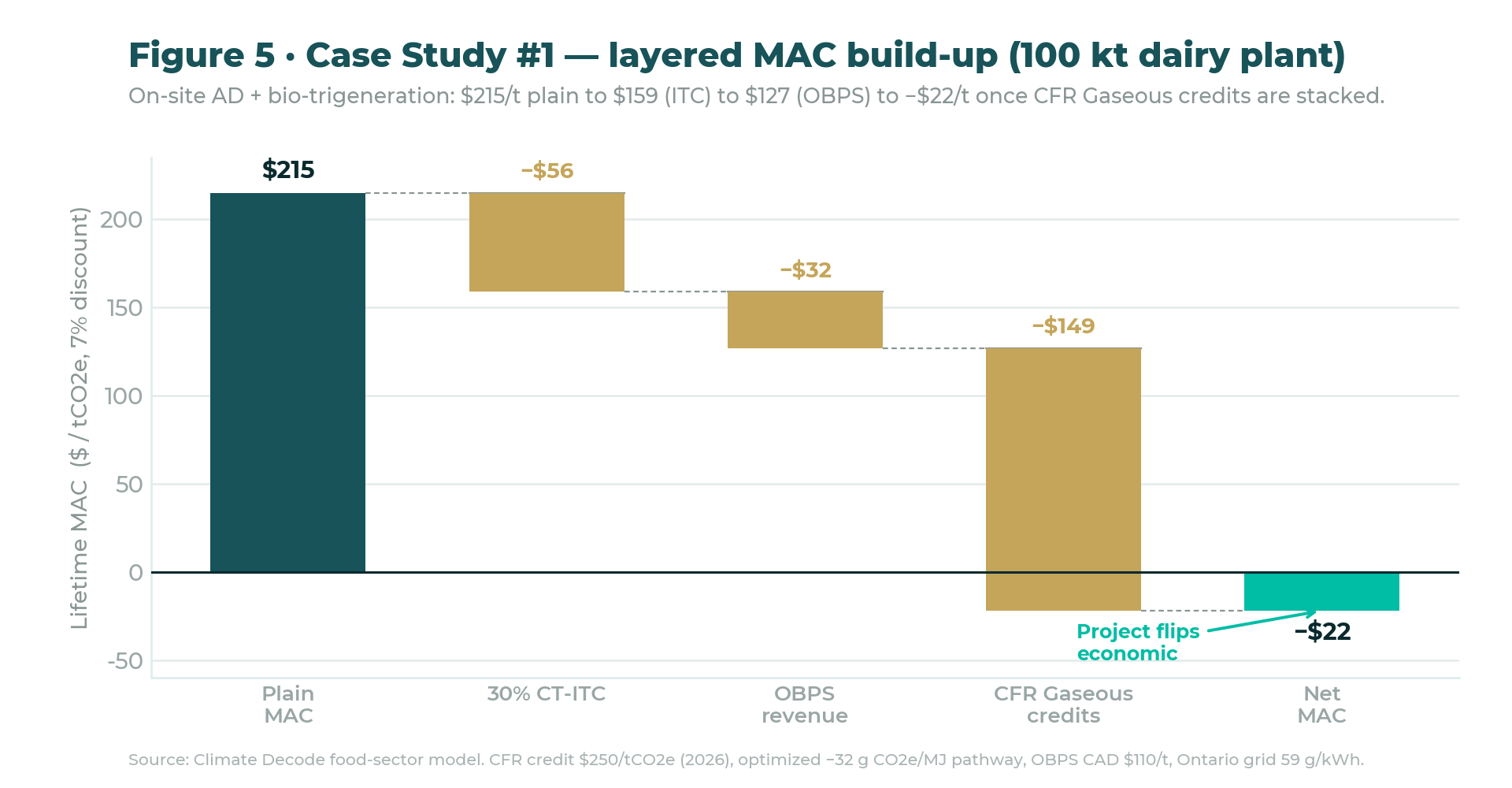
Case 1 — on-site anaerobic digestion + bio-trigeneration at a 100 kt dairy plant: the plain MAC of CAD $215/tCO₂e falls to a net −$22/tCO₂e once the 30% Clean Technology ITC, OBPS carbon-price revenue and CFR Gaseous Class credits are stacked on an optimized −32 gCO₂e/MJ lifecycle pathway. The full report shows every layer, the sensitivity grid, and the conditions that make it bankable.
Get the full report
Enter your details to access the complete Pathways report — all the figures, the full MAC build-ups, the lever catalogue, the five-KPI matrix, and both case studies.
- ✓Five lever families, fully characterised
- ✓Two case studies with layered MAC math
- ✓Carbon-market & tax-incentive tables
- ✓The five-KPI screening matrix
No spam. Unsubscribe anytime. By submitting you agree to our privacy policy.