What's inside
Pulp & paper sits at the intersection of three forces: capital scarcity, tightening carbon regulation, and a fast-evolving market for carbon credits and tax incentives. This white paper sets out the decarbonization toolkit in operational, not aspirational, terms — connecting mill-level data to an emissions baseline, then to a marginal abatement cost (MAC) curve, then to a financing plan that captures every available revenue layer.
Through two worked case studies, it shows exactly how compliance carbon prices, tax credits, fuel-side credits, and voluntary removal credits combine to determine which projects clear an investment committee.
Full contents
- 01State of the Industry
- 02The Production Process & Its Energy Profile
- 03Building a Hypothetical Mill & Its Hotspots
- 04Decarbonization Solutions (six families)
- 05Carbon Markets, Tax Incentives & Two Case Studies
- 06How Climate Decode TerraNova Helps
- 07Conclusions & Recommendations
- 08The IEA Sector Pathway to 2050
A sample from inside
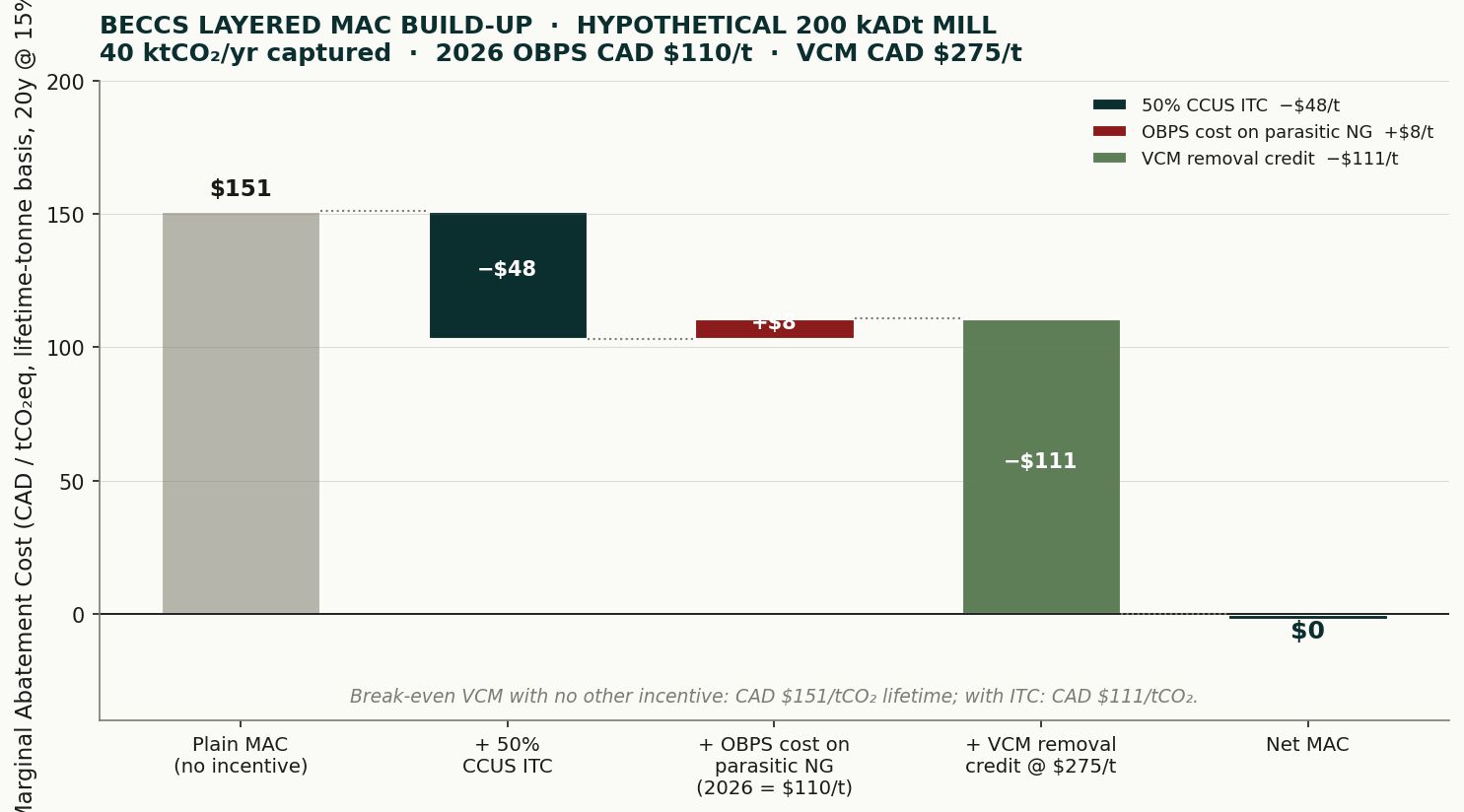
Case 1 — BECCS at the recovery and biomass boilers: the plain MAC of CAD $151/tCO₂ falls to break-even only once the 50% CCUS ITC and a CAD $275/tCO₂ voluntary-removal offtake are stacked. The full paper shows every layer, the sensitivity tables, and the three configuration conditions that make it bankable.
Get the full white paper
Enter your details to access the complete white paper — all ten figures, the full MAC build-ups, the lever catalogue, and both case studies.
- ✓Six lever families, fully characterised
- ✓Two case studies with layered MAC math
- ✓Carbon-market & tax-incentive tables
- ✓The IEA sector pathway to 2050
No spam. Unsubscribe anytime. By submitting you agree to our privacy policy.