HomeInsightsDecarb Series › White Paper
Decarb Series · White Paper
Pulp & PaperMACC · BECCS · CFRGated · May 2026

Pulp & Paper Decarbonization: The Full White Paper

Process emissions, carbon markets, and capital discipline on the path to net zero — emissions hotspots, six lever families, a marginal abatement cost curve, and two worked case studies with full financing math.

By Koorosh Behrang · Founder, Climate Decode · · The full report

BECCS · LAYERED MAC (CAD/t)$151Plain$103+ITC$111+OBPS$4+VCMStack the policy layers → the project clears.
Reference mill
200 kADt/yr
integrated kraft mill, fully modelled
Decarbonization levers
6 families
from energy efficiency to BECCS
Worked case studies
2 cases
BECCS & on-site biogas, full math
White Paper

What's inside

Pulp & paper sits at the intersection of three forces: capital scarcity, tightening carbon regulation, and a fast-evolving market for carbon credits and tax incentives. This white paper sets out the decarbonization toolkit in operational, not aspirational, terms — connecting mill-level data to an emissions baseline, then to a marginal abatement cost (MAC) curve, then to a financing plan that captures every available revenue layer.

Through two worked case studies, it shows exactly how compliance carbon prices, tax credits, fuel-side credits, and voluntary removal credits combine to determine which projects clear an investment committee.

Full contents

  • 01State of the Industry
  • 02The Production Process & Its Energy Profile
  • 03Building a Hypothetical Mill & Its Hotspots
  • 04Decarbonization Solutions (six families)
  • 05Carbon Markets, Tax Incentives & Two Case Studies
  • 06How Climate Decode TerraNova Helps
  • 07Conclusions & Recommendations
  • 08The IEA Sector Pathway to 2050

A sample from inside

Case 1 — BECCS at the recovery and biomass boilers: the plain MAC of CAD $151/tCO₂ falls to break-even only once the 50% CCUS ITC and a CAD $275/tCO₂ voluntary-removal offtake are stacked. The full paper shows every layer, the sensitivity tables, and the three configuration conditions that make it bankable.
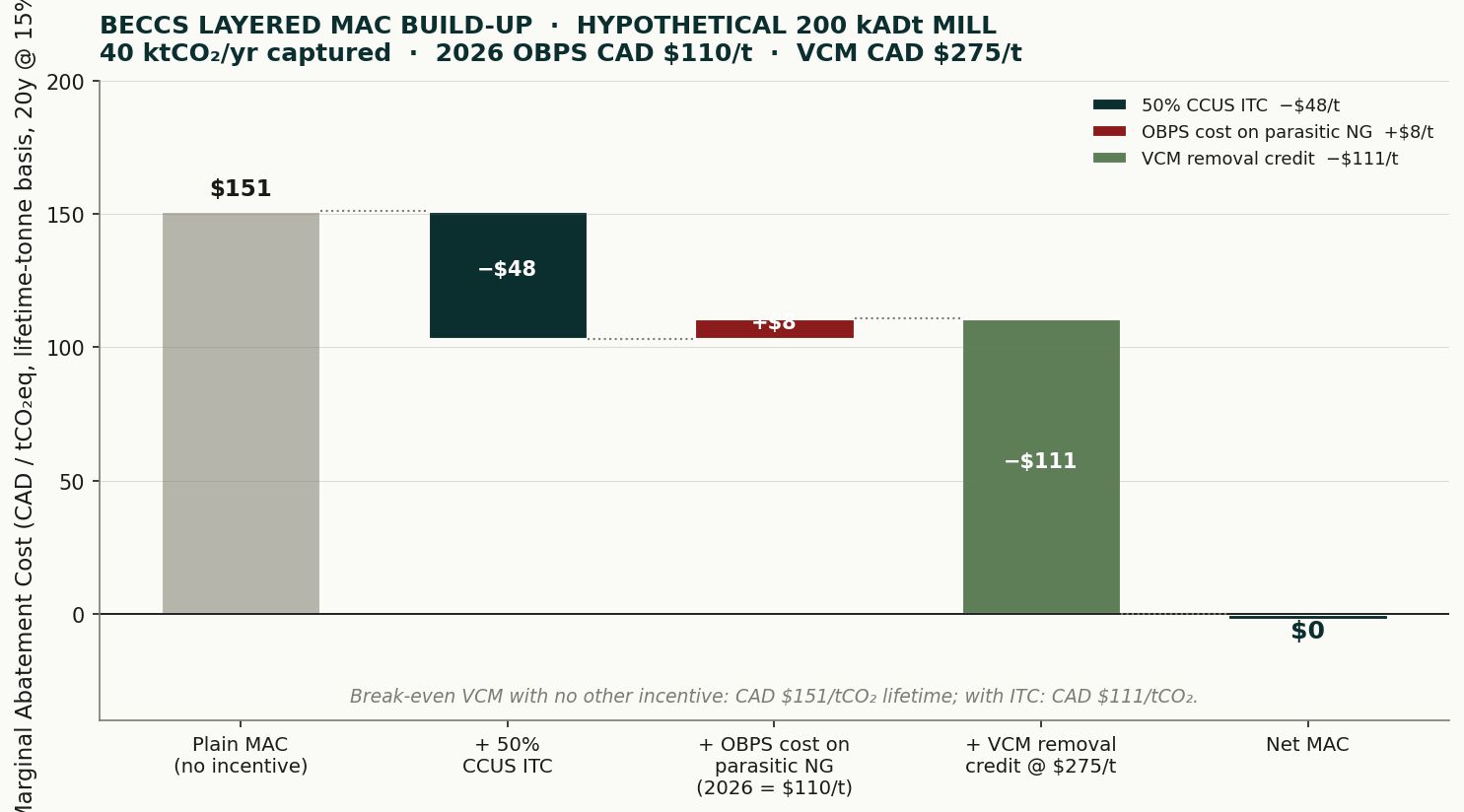
Sample figure from the white paper: BECCS layered marginal abatement cost build-up
A sample figure from Section 5 — the BECCS layered MAC build-up. The full paper includes ten figures and the complete data tables.
Free · Gated download

Get the full white paper

Enter your details to access the complete white paper — all ten figures, the full MAC build-ups, the lever catalogue, and both case studies.

  • Six lever families, fully characterised
  • Two case studies with layered MAC math
  • Carbon-market & tax-incentive tables
  • The IEA sector pathway to 2050

No spam. Unsubscribe anytime. By submitting you agree to our privacy policy.

Executive Summary

The Argument in Brief

Where the emissions sit

The two case studies, in one line each

BECCS at the recovery and biomass boilers clears only with the 50% Canadian CCUS ITC and a long-dated voluntary removal offtake at CAD $275/tCO₂ or above. On-site biogas clears comfortably on a ~7-year payback once CFR Gaseous Class credits are layered on an optimized lifecycle carbon intensity — and loses money without a registered CFR pathway.

The recurring finding

The binding constraint is rarely the technology, and rarely the headline carbon-price level — it is the multi-year readability of the full revenue stack to a capital-allocation committee, at year zero and again at year ten.

Short on time? The free Short Paper covers the levers and both case studies in a 10-minute read — no form required.

TerraNova by Climate Decode

The whole workflow in this paper, in one platform.

TerraNova ingests mill operations data, allocates emissions to each process step, screens more than fifty levers against the local policy stack, and returns a finance-grade investment plan — ranked portfolio, deployment schedule, NPV/IRR by lever, and year-by-year compliance position.

Explore TerraNova →Request a Demo
Continue in the Decarb Series

The free Short Paper  ·  SBTi Target Setting for Pulp & Paper  ·  CDR Series

Koorosh Behrang
Written by

Koorosh Behrang

Founder, Climate Decode · Industrial Decarbonization & Carbon Markets

Founder of Climate Decode with more than 10 years across decarbonization strategy, corporate sustainability, Net Zero target setting, and compliance carbon markets. Leads the development of TerraNova — Climate Decode's platform for emissions baselines, marginal abatement cost curves, and finance-grade project economics.

Meet the team →

Build your mill's decarbonization investment plan.

TerraNova turns mill operations data into a finance-grade roadmap — emissions hotspots, a marginal abatement cost curve, NPV/IRR by lever, and policy-aware economics across every revenue layer.