What the CFR Amendments Mean for RNG: Pipeline or Pump
Environment and Climate Change Canada’s draft amendments would add 40% to the credits on Canadian renewable natural gas used as vehicle fuel, cap credits from imported gaseous fuels at 5% of a supplier’s requirement and set a default carbon intensity that earns credits. The route a producer chooses decides how much of that it captures.
At a Glance · RNG Under the Proposed Amendments
|
Vehicle route +40% ON CANADIAN RNG AT THE PUMP A related credit of 0.4 times the producer’s and the station’s credits on Canadian RNG dispensed to vehicles, from the 2026 compliance period if adopted as drafted. |
Imported gas 5% CAP ON IMPORTED GASEOUS CREDITS Within the 10% cap on all gaseous-class credits. Imported RNG was 63% of the RNG volume that created credits in the second and third quarters of 2025, and 15% of the credits. |
Route choice 148 OR 207 CREDITS PER 1,000 GJ An SSO project at a CI of −80 in 2027 earns 148 credits by pipeline and 207 at the pump with the related credit, where credits carry no use limit. |
The draft amendments would add a 40% related credit on Canadian RNG supplied to vehicles, limit credits from imported gaseous fuels to 5% of a supplier’s requirement and replace the fixed default carbon intensity with one that earns credits. They leave the base formula unchanged, so at the same carbon intensity the producer’s credit per megajoule remains the same by pipeline and at the pump.
Only credits on Canadian RNG supplied to vehicles would earn the related credit, and credits on RNG supplied to vehicles can be used without limit, while gaseous credits stay capped at 10% of each buyer’s requirement. Per 1,000 GJ in 2027, an SSO project at −80 earns 148 credits by pipeline and 207 at the pump with the related credit, so the carbon intensity sets the scale of the credit and the route sets its value. The choice of route turns on how much CNG the contracted stations dispense, who keeps the station’s credits and the cost of the extra reporting.
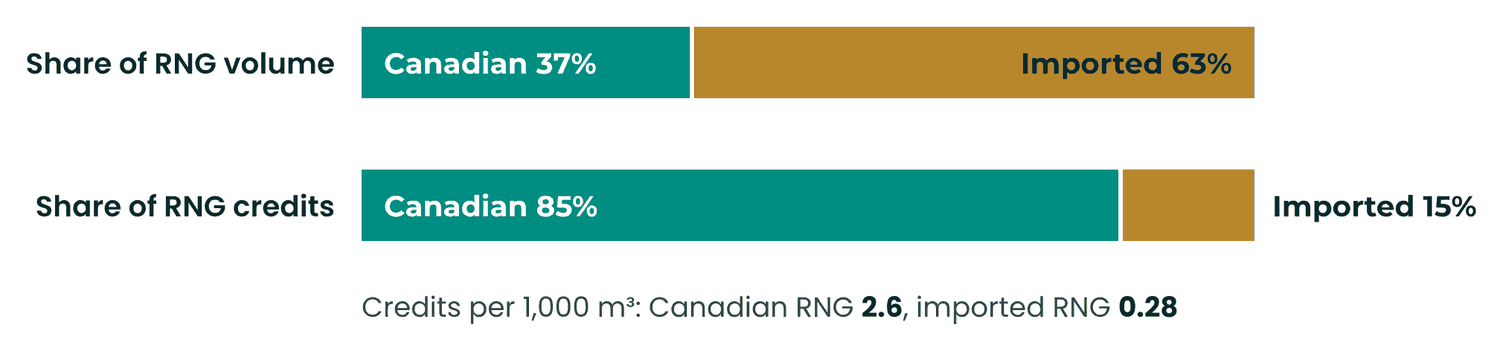
Imported RNG was 63% of the RNG volume that created CFR credits in the second and third quarters of 2025 but 15% of the credits. The new limit would let imported gaseous credits fill at most half of the 10% cap, and imported RNG supplied to Canadian stations, which stays outside both limits, would earn no related credit.
|
1
|
What the Draft Amendments Change for RNG |
The amendments are still proposed and may change before registration. If adopted as drafted, they would take effect on registration, and the related credit would apply to credits created from the 2026 compliance period. The proposal was published in the Canada Gazette, Part I, on 31 October 2026, opening a 75-day consultation that ECCC says closes on 14 January 2027.1,2
Table 1 · What the draft amendments change for RNG. Rules as drafted in ECCC’s text of 22 October 2026, released on 27 October. Credits per megajoule from the reference carbon intensities in Schedule 1 of the Clean Fuel Regulations.2,3,4
|
2
|
At the Same Carbon Intensity, Both Routes Pay the Producer the Same per Megajoule |
A producer or importer of renewable natural gas (RNG) can create credits under the Clean Fuel Regulations in two ways. Gas injected into the natural gas system to displace natural gas creates credits in the gaseous class under section 95. Gas supplied to a fuelling station and dispensed to vehicles creates credits in the liquid class under section 100, and the station owner or operator creates a second set under section 99 that does not depend on the gas’s carbon intensity.4
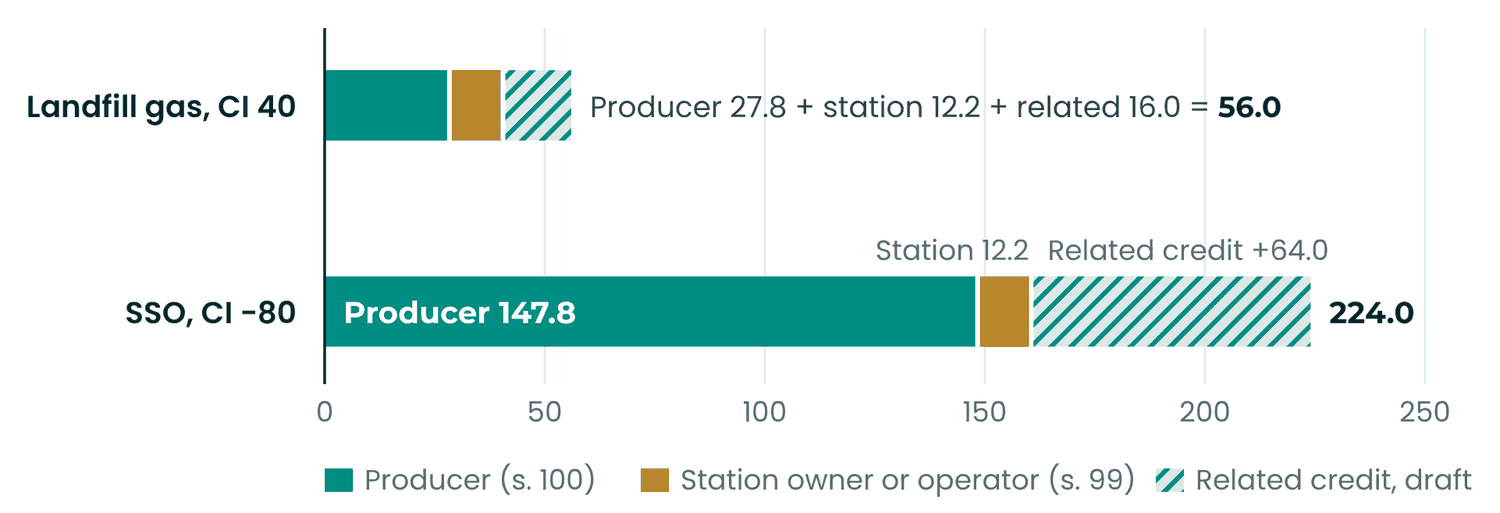
For the same carbon intensity, the producer’s credit per megajoule is the same on both routes. It equals the reference carbon intensity for RNG in Schedule 1, 67.8 gCO₂e/MJ, less the carbon intensity (CI) of the gas. A landfill-gas project with a CI of 40 earns 27.8 grams a megajoule on either route, and a project on source-separated organic waste (SSO) at −80 earns 147.8. Section 95(2)(d) prevents the same gas from being credited twice.
Section 15(2) lets a primary supplier use gaseous-class credits for no more than 10% of its total reduction requirement, and liquid-class credits on RNG supplied to vehicles carry no such limit. A gaseous credit therefore sells into a capped share of compliance demand, while a credit on RNG supplied to vehicles can meet any part of it.
Table 2 · The two routes for RNG under the Clean Fuel Regulations. Sources: Clean Fuel Regulations, sections 15, 95, 99 and 100 and Schedules 1 and 6; ECCC, Specifications for Fuel LCA Model CI Calculations, sections 5.2 and 5.4; draft amendments of 22 October 2026. Station credit for compressed RNG at the Schedule 6 values.3,4,5
Market Watch subscribers receive the modeled CFR balance, bank and price paths by year, with and without the draft amendments.
Book a briefing → Subscribe to insights →|
3
|
Pipeline Gas Can Reach the Pump Through a Contract |
Section 100(1) accepts RNG supplied to a fuelling station “by means of a contractual agreement”, so a producer does not need its own station or trucks to use the vehicle route. The supporting documents must name the station owner or operator, state the quantity supplied to the station in the period, show that the quantity credited does not exceed what the station dispensed to vehicles and, for contractual supply, establish a physical connection between the station and the producer.4
ECCC’s Specifications for Fuel LCA Model CI Calculations then change how the CI is modeled. Gas injected into a common pipeline with no identified end user can use a predefined pipeline scenario (section 5.2). Gas supplied to a station under contract is modeled on the actual distance from the production facility to the injection point and through the pipeline to the station (section 5.4).5
Credits on the vehicle route are capped at the volume dispensed to vehicles at the contracted stations, so the route is only as large as the compressed natural gas (CNG) demand of the fleets those stations serve. A producer can send what contracted stations dispense to the liquid class and the rest to the gaseous class.
|
4
|
On Low-CI Gas the Producer Keeps Most of the Credit, and the Station Earns the Fuel Switch |
Section 99(3) credits the station owner or operator for replacing diesel or gasoline with compressed gas. For compressed RNG at the Schedule 6 values, the credit per megajoule is the liquid-class reference CI less 72 gCO₂e/MJ, the Schedule 6 value for compressed natural gas, plus 0.2 grams (the 68 grams of natural gas less the RNG reference of 67.8). It does not depend on the CI of the RNG. It is 12.2 grams in 2027 and falls to 8.3 from 2030, as the liquid-class reference steps down from 84.0 to 80.1.4
The value of a low CI therefore goes entirely to the producer. In ECCC’s own illustration, RNG at 5 gCO₂e/MJ gave the producer 62.8 grams and the station 17.4 on the 2022 reference, a 78% share for the producer.6 An SSO project at −80 in 2027 earns 147.8 grams against the station’s 12.2, or 92%. Above a CI of about 56 in 2027 the station earns more than the producer.

|
5
|
The Draft Amendments Raise the Value of the Vehicle Route and Cap Imported Gas |
A 40% related credit on Canadian RNG used in vehicles. New subsection 19(3) would let the creator of a credit under subparagraph 19(1)(d)(ii) or (iii), the station and producer routes, create a related credit when the fuel was produced in Canada. The number is P × N × Fr, where N is the number of underlying credits, P is 1 for these routes and Schedule 3.1 sets Fr at 0.4 for RNG, compressed or liquefied. Both the producer’s and the station’s credits on Canadian RNG would rise by 40%. Gaseous-class credits earn no related credit, and neither does imported RNG.3 Our sizing of the related credits covers the other fuels.
A 5% limit on imported gaseous credits. New subsection 15(2.1) would cap the credits a primary supplier uses from imported gaseous fuels (created under paragraph 20(b)) and from gaseous-class projects outside Canada at 5% of its total reduction requirement. The 10% cap on all gaseous-class credits stays, so imported gas could fill at most half of it.3 In the second and third quarters of 2025, imported RNG was 63% of the RNG volume that created CFR credits and 15% of the credits (gaseous and vehicle credits combined). Canadian RNG earned about 2.6 credits per 1,000 m³ and imports about 0.28, a gap consistent with much lower carbon intensities for Canadian gas.7 Imported RNG supplied to Canadian fuelling stations under section 100 remains in the liquid class, outside both limits, but neither the importer’s nor the station’s credits on it earn a related credit.
A default carbon intensity that earns credits. A producer without an approved CI can use the fixed default in section 1 of Schedule 6 for up to 12 months, or longer while a CI application is pending (section 75(2) and (3)). That default is 77 gCO₂e/MJ in 2026 and 76 in 2027, above the 67.8 reference, so it earns nothing.4 The draft replaces it with 61 gCO₂e/MJ for biogas, RNG and hydrogen not produced from fossil fuel, worth 6.8 grams a megajoule. Section 88 already lets a creator claim the difference for the three compliance periods before its CI is approved, and the draft would add the part of the approval year before the approval date.3 With the draft default, a new project would earn credits on its first volumes while its CI application is reviewed and true them up after approval.
Our review of the full amendments covers the funding-program limit, the reporting changes and the effect on the wider market.
|
6
|
Per 1,000 GJ Under the Draft, an SSO Project Earns 148 Credits by Pipeline and 207 at the Pump |
Table 3 sets out the credits on 1,000 GJ of Canadian RNG in 2027 at three carbon intensities, the draft default of 61, an illustrative landfill-gas project at 40 and an illustrative SSO project at −80.
Table 3 · Credits on 1,000 GJ of Canadian RNG in 2027 (one credit per tonne of CO₂e). Producer credits are 67.8 less the CI; the station credit, for compressed RNG at the Schedule 6 values, is 84.0 − 72 + 0.2; the related credit applies P = 1 and Fr = 0.4. The 61 row applies only under the draft; the default in force in 2027, 76, earns nothing. Gaseous credits can be used for up to 10% of a supplier’s requirement; credits on RNG supplied to vehicles carry no limit.3,4
Two conclusions follow. First, the carbon intensity sets the scale of the credit. At −80 the project earns 22 times the credits of gas at the draft default, on either route. Second, the route sets the value. At C$331, ECCC’s third-quarter 2026 average across all priced transfers, the SSO project’s liquid-class credits are worth about C$49 per GJ today and C$68 per GJ with the related credit.8 Its gaseous credits can be used for only a limited share of each buyer’s requirement, so we price them separately in our model.
The choice also turns on what the table leaves out, chiefly how much CNG the contracted stations dispense, who keeps the station’s credits and its related credit, and the cost of the extra reporting. The related credit lifts the station’s credit from 12.2 to 17.1 grams a megajoule, a gain worth pricing into the supply contract.
|
7
|
How Climate Decode Helps RNG Producers Monetize and Forecast Their Credits |
We work with RNG producers and importers from the route decision to the sale of the credits.
- Route and contract structuring. Which volumes go to the pipeline and which to fuelling stations, the contractual route under section 100 and section 5.4 of the Specifications, and supply terms with station operators, including who holds the station credits and the related credit.
- Carbon-intensity strategy. Fixed default, calculated default or a Fuel LCA Model application, timed so that early volumes can be trued up once the CI is approved.
- Registration, reporting and verification. Registered-creator set-up, the supporting documents each route requires, quarterly and annual credit-creation reports, and third-party verification.
- Revenue forecasting. Our CFR market model projects liquid- and gaseous-class credit prices with and without the draft amendments, with P10 to P90 ranges, and turns them into project revenue by route, carbon intensity and year, with sensitivities to the CI, the volume dispensed to vehicles and the start date.
- Credit sales. Timing, counterparties and contract terms for selling or banking the credits.
Market Watch subscribers receive the modeled CFR balance, bank and price paths by year. For a project, we build the revenue case on the same model.
Climate Decode Platform
Market Watch models the CFR alongside the BC, California, Oregon and Washington fuel standards, and our clean fuels advisory turns it into credit generation and project decisions.
Credit creation, transfers, prices and the modeled balance, bank and price paths with and without the amendments.
Open Market Watch →Route and contract structuring, carbon-intensity strategy, registration and credit sales for RNG producers and importers.
Explore advisory →Notes and Sources
- Canada Gazette, Part I, Vol. 160, No. 44, 31 October 2026, Regulations Amending the Clean Fuel Regulations and the Environmental Violations Administrative Monetary Penalties Regulations, proposed, with the Regulatory Impact Analysis Statement. link
- Environment and Climate Change Canada, Canada proposes changes to support the low-carbon fuel industry, news release, 27 October 2026, on the 75-day public consultation. link
- Environment and Climate Change Canada, Regulations Amending the Clean Fuel Regulations and the Environmental Violations Administrative Monetary Penalties Regulations, pre-publication text, file 81000-2-6067, dated 22 October 2026: new subsections 15(2.1) and 19(3) to (6), amended section 88, Schedule 3.1 and Schedule 6. link
- Clean Fuel Regulations, SOR/2022-140, consolidated to 26 May 2026: sections 15, 19, 20, 75, 88, 95, 99 and 100 and Schedules 1 and 6. link
- Environment and Climate Change Canada, Specifications for Fuel LCA Model CI Calculations, version 5.0, sections 5.2 and 5.4. link
- Environment and Climate Change Canada, Clean Fuel Regulations, Compliance Category 3: Fuel or Other Energy Source for Vehicles, technical presentation, March 2023, slide 18 (crediting split between producer and fuelling station); technical presentations are available from ECCC on request. link
- Environment and Climate Change Canada, Clean Fuel Regulations 2025 Quarterly Credit Market Reports, Q1, Q2 and Q3, Table 3. link
- Environment and Climate Change Canada, CFR Compliance Credit Market Dataset (Monthly and Quarterly), September 2026 edition, third-quarter 2026 average across all priced transfers, C$330.93. link
About this analysis. Credits per megajoule apply the reference carbon intensities in Schedule 1 of the Clean Fuel Regulations: 67.8 gCO₂e/MJ for RNG in every year, and 84.0 for the liquid class in 2027 and 80.1 from 2030. The station credit on compressed RNG uses the Schedule 6 values of 72 gCO₂e/MJ for compressed natural gas and 68 for natural gas. The related credit applies P = 1 and Fr = 0.4 from the draft amendments. Credits on 1,000 GJ equal the grams per megajoule, at one credit per tonne of CO₂e, and values per GJ multiply those credits by ECCC’s third-quarter 2026 average across all priced transfers, C$330.93. The landfill-gas and SSO carbon intensities are illustrative. Everything here is published data or arithmetic on it; nothing comes from our forecast.
The related credit, the import limit and the default carbon intensity are proposed and may change before registration. This article is analytical research provided for information only and is not investment advice.
About the Author

|
© 2026 Climate Decode · Market Analysis · Reference CD-CFR-RNG |
Series Home Insights Home Contact Us |