How Canada’s CFR Reshapes Biogas Value: From C$7 to C$60/GJ
How end use, carbon intensity, facility design and offtake terms determine what a GJ of biogas earns, and how projects can capture more of it.
Key Takeaways
- Route choice dominates value: at CI 10, Ontario power is worth C$6.77/GJ with no CFR credits, versus C$41.62/GJ for pipeline RNG when the producer retains the credits.
- On-site use at an OBPS facility reaches C$26.40/GJ without pipeline-quality upgrading, combining avoided gas purchases, CFR credits and avoided OBPS cost.
- Vehicle RNG reaches C$49.27/GJ only if the related credits proposed on 31 October 2026 take effect, and C$59.55/GJ in BC with BC LCFS credits. Without the proposed related credits, it is worth the same as pipeline RNG.
- CI is a major value lever: approved RNG CIs on ECCC’s public list range from −106 to 12 g/MJ, a C$39.05/GJ spread in gaseous-class credit value.
- Before signing an offtake, lock down three points: the CI, credit ownership, and credit-price risk.
At a Glance · One GJ of Biogas at CI 10
|
Route C$6.77 TO C$59.55 PER GJ From power in Ontario, which earns no CFR credits at CI 10, to vehicle RNG in BC with CFR, related and BC LCFS credits, at Q3 2026 prices. |
Credits C$19 TO C$37 PER GJ CFR and BC LCFS credits on top of a C$22.49/GJ RNG price. Vehicle RNG keeps its lead over pipeline RNG only if the proposed related credits take effect. |
Carbon intensity C$39.05 PER GJ CI SPREAD Approved RNG CIs on ECCC’s public list run from −106 to 12 g/MJ. Every 10 g/MJ is worth C$3.31/GJ in the gaseous class. |
At Q3 2026 prices, one GJ of biogas at a carbon intensity (CI) of 10 g/MJ is worth C$6.77 as power in Ontario and as much as C$59.55 as vehicle fuel in BC. The energy component accounts for roughly C$2.50 to C$22.50/GJ; the rest comes from Clean Fuel Regulations (CFR) credits, BC Low Carbon Fuel Standard (BC LCFS) credits and avoided carbon costs under the federal output-based pricing system (OBPS).
Route selection is the first value decision. Feedstock and facility design then set the CI, the offtake determines who keeps the credits and RNG premium, and book and claim can connect production to a distant buyer. Together, these choices can change the realized value of a GJ almost as much as the end-use route itself.
Vehicle RNG reaches C$49.27/GJ only if the related credits proposed on 31 October 2026 take effect; without them, it is worth the same as pipeline RNG. Before signing an offtake, a producer should lock down the CI, who owns each credit and who carries credit-price risk.
|
1
|
Credits Can Add C$19 to C$37/GJ on Top of a C$22.49 RNG Price |
Figure 1 compares five routes for one GJ of biogas at a CI of 10 g/MJ using Q3 2026 prices. Each bar separates the energy value, CFR credits, any avoided OBPS cost and, where applicable, BC LCFS credits. CFR credits are valued at ECCC’s Q3 2026 average of C$330.93/t.1

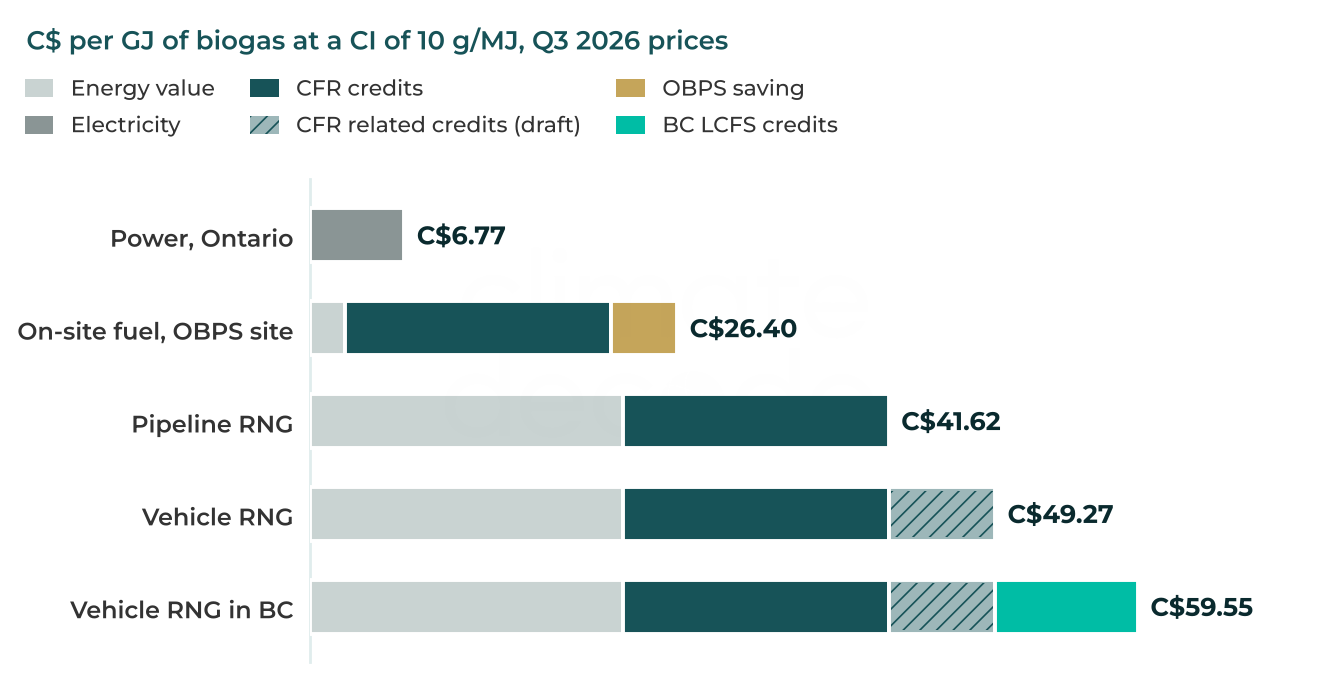
Because the three RNG sale routes use the same C$22.49/GJ RNG price, every difference between them comes from credit value.
|
2
|
Ontario Power Earns C$6.77/GJ and No CFR Credits at CI 10 |
At 38% electrical efficiency, one GJ of biogas produces about 106 kWh. At Ontario’s 2025 average market price of C$64.10/MWh, that electricity is worth C$6.77/GJ.3 For context, Ontario’s FIT program paid biogas plants of 500 kW to 5 MW 14.7¢/kWh, equivalent to about C$15.50/GJ of biogas,8 and biogas contracts with the IESO begin expiring as early as 2030.9
At a biogas CI of 10 g/MJ, the electricity earns no CFR credits. Section 96 credits the gap between the provincial grid CI, 14 g/MJ in Ontario, and the CI of electricity generated from biogas.10 Dividing the biogas CI by the engine efficiency turns 10 g/MJ into 26.3 g/MJ, leaving a negative crediting gap.
In Ontario, power begins earning credits only when the biogas CI falls below 5.3 g/MJ (14 × 0.38). Quebec, Manitoba and BC have cleaner grids, so their thresholds are lower still. Even the most efficient large engines leave electricity from CI-10 biogas at roughly 22 to 24 g/MJ.
Combined heat and power (CHP) can qualify differently. Under s.95(3), equipment whose electricity and useful heat together exceed 70% of the biogas energy can claim the gaseous-class credit on all of its biogas.10 At a CI of 10, that credit is 57.8 kg/GJ, worth C$19.13 at C$330.93/t.
Our Market Insights service tracks prices and market balances across six North American clean fuel programs each quarter.
Book a briefing → Subscribe to insights →|
3
|
Pipeline RNG Reaches C$41.62/GJ When the Producer Retains the CFR Credits |
Once upgraded and injected into the gas grid, the same GJ can be sold as renewable natural gas (RNG). We value the gas at the natural gas price plus C$20/GJ, or C$22.49/GJ, matching Énergir’s customer RNG rate from 1 October 2026.5 Énergir’s 2024 call for tenders averaged more: C$26.47/GJ in 2026 dollars.11
The producer can also create CFR credits. At a CI of 10, the gaseous-class credit is 57.8 kg/GJ, the 67.8 g/MJ reference less the 10 g/MJ CI, worth C$19.13 at ECCC’s Q3 2026 average of C$330.93/t.10,1 Together, the RNG and credits are worth C$41.62/GJ, more than six times the Ontario power route.
Credit ownership is contractual. FortisBC’s supply contracts assign environmental attributes, including CFR credits, to the utility unless a side letter shares them with the supplier.12 Enbridge has said it may buy RNG with or without the credits,13 while Énergir’s projected RNG costs exclude credit value.14
If the buyer takes the credits, the RNG price should compensate for them. Otherwise, close to half of the C$41.62/GJ value transfers with the environmental attributes.
|
4
|
On-Site Use at an OBPS Facility Reaches C$26.40/GJ Without Pipeline-Quality Upgrading |
An industrial site covered by the OBPS can burn its own biogas instead of natural gas. Because nothing is sold, there is no RNG premium. The value comes from three sources: C$2.49/GJ of avoided natural gas purchases,4 C$19.13/GJ of CFR credits and the avoided OBPS carbon cost.
Each GJ of natural gas carries about 0.050 t of CO₂ under the OBPS. Replacing it avoids C$4.78/GJ at the 2026 price of C$95/t, rising to C$5.78/GJ at C$115/t in 2030.6 At 2026 prices, the total value is C$26.40/GJ.
This route can also reduce capital requirements. Boiler fuel needs cleaning, but not upgrading to pipeline quality, and there is no grid connection; together, those steps can save roughly C$6 to C$13/GJ. A facility that pays a delivered gas price would also avoid more than the commodity price used in this analysis.
|
5
|
Vehicle RNG Reaches C$49.27/GJ Under the Draft Amendments and C$59.55/GJ in BC |
Sold to a CNG or LNG station, RNG carries the same C$22.49/GJ gas value, but the CFR credits come through the fuel-switching rules. The station earns its own credit for displacing diesel, 13.5 kg/GJ in 2026 for compressed RNG, while the RNG producer earns a liquid-class credit on the gap between the 67.8 g/MJ reference and the RNG CI.10
At a CI of 10, the producer’s credit is 57.8 kg/GJ, the same quantity as for pipeline RNG. The difference is class: it is a liquid-class credit, which suppliers can use without the 10% limit that applies to gaseous-class credits.10
The amendments proposed on 31 October 2026 would add 0.4 related credits for every liquid-class credit from Canadian RNG used in vehicles. At CI 10, the producer’s credit would rise to 80.9 kg/GJ, worth C$26.78, lifting total value to C$49.27/GJ. Comments on the draft close around 14 January 2027.7
Without the proposed related credits, vehicle RNG is worth C$41.62/GJ, the same as the pipeline route. The draft gives pipeline RNG no multiplier. It would, however, cap imported gaseous-class credits at 5% of a supplier’s requirement, reserving half of the 10% gaseous-class allowance for Canadian gas.7
In BC, the same GJ can also create BC LCFS credits. Using BC’s 2026 diesel limit of 74.94 g/MJ and an energy effectiveness ratio of 0.9, a CI of 10 earns 57.4 kg/GJ.15 At the Q3 2026 average of C$179/t, that adds C$10.28/GJ, bringing total value to C$59.55/GJ.2
BC LCFS credits generally accrue to the party supplying fuel at the station, so a producer participates only if the contract provides for it.16 The station does not need to be near the plant: ECCC’s CI specifications allow RNG to be contracted from the gas grid, with pipeline distance included in the CI.17
A GJ can support a credit claim only once. RNG used to generate US credits cannot also generate CFR credits.10
|
6
|
RNG Production Costs Span C$10 to C$43/GJ, While Lower-CI Feedstocks Often Cost More |
The 2022 B.C. supply potential study, after converting US estimates, puts RNG production costs at roughly C$10 to C$43/GJ. Landfill gas and wastewater sit at the low end because the study counts only upgrading costs where gas collection or digestion already exists. Food waste and manure are more expensive; the study found no B.C. supply from agricultural or municipal biogas plants below C$18/GJ once digestate handling is included.18
Table 1 · RNG production cost and approved CFR CI vary sharply by feedstock. Cost ranges are American Gas Foundation (2019) estimates converted to Canadian dollars in the B.C. study (Table 7). CIs are from ECCC’s approved CI list dated 30 September 2025; most RNG values on that list are confidential.18,19
The American Gas Foundation’s 2025 study places US manure, food-waste and thermal RNG higher, at US$25 to US$40/MMBtu, or roughly C$33 to C$53/GJ.20,21
Against these cost ranges, pipeline RNG at CI 10 is worth C$41.62/GJ, enough to cover every range in Table 1 except the high end of manure. On-site use is worth less, at C$26.40/GJ, but avoids upgrading, an important advantage for industrial facilities that already treat effluent in a digester.
Higher-cost feedstocks can also deliver much lower CIs. At the approved manure CI of 0, pipeline RNG is worth C$44.93/GJ; at the approved biogenic-waste CI of −106, it reaches C$80.01/GJ. Those values exceed even the higher 2025 production-cost estimates.
Scale and distance can push a project toward the top of its cost range. The B.C. study estimates that trucking RNG to an injection point adds C$3 to C$6/GJ or more.18
|
7
|
Five Levers Determine Project Value; CI Alone Can Shift It by C$39/GJ |
Once the route is chosen, five variables determine how much value the project creates and how much the producer keeps.
- Feedstock CI. Every 10 g/MJ reduction in CI adds C$3.31/GJ in the gaseous class or C$4.63/GJ for vehicle RNG under the draft. ECCC’s approved RNG CIs span −106 to 12 g/MJ, a C$39.05/GJ spread.19 The proposed default CI of 61 g/MJ yields C$2.25/GJ.7
- Facility design. Methane slip, upgrading electricity and digester heat all affect CI. Destroying tail-gas methane and using biogas or waste heat for digester heating can increase credit value.
- Offtake terms. The contract determines who creates and retains each CFR and BC LCFS credit. Separating RNG price from credit value makes the transfer explicit and ensures the buyer pays for credits it receives.
- Book and claim. A producer can contract with a station or utility anywhere on the connected gas grid. Pipeline distance is included in the CI, and each GJ can support only one credit claim.17,10
- Credit-price exposure. The CFR average rose from C$111/t in Q3 2023 to C$330.93/t in Q3 2026;1 California’s LCFS average fell from US$199/t in 2020 to US$60/t in 2025.22 Fixed pricing shifts risk to the buyer, indexing to the producer, and a floor shares the downside.
|
8
|
Three Questions to Answer Before Signing an Offtake |
An offtake can lock in these value levers for years. Resolve three questions before signing.
- What is the CI? Use a project-specific estimate based on feedstock and facility design. At CI 10, a GJ earns C$16.88 more in gaseous-class credit value than at the proposed default CI of 61.
- Who creates and keeps each credit? Name every credit and environmental attribute in the contract, and confirm whether the stated RNG price assumes that the producer retains them.
- Who carries credit-price risk? The CFR average roughly tripled in three years; California’s LCFS average fell by more than two-thirds. Decide whether pricing is fixed, indexed or floored, and for how long.
At CI 10, the same GJ of biogas is worth C$6.77 as Ontario power and C$59.55 as vehicle fuel in BC. The route sets the opportunity; feedstock, facility design and contract terms determine how much of that value the project can capture.
Climate Decode Platform
Our Market Insights service tracks prices and market balances across six North American clean fuel programs each quarter. We also develop CFR projects from CI pathway design through credit creation, and build financial models for fuel-switching decisions.
Credit creation, transfers and prices, with the modeled balance, bank and price paths for the CFR.
Open Market Watch →CI pathway design through credit creation, offtake terms and financial models for fuel-switching decisions.
Explore advisory →Notes and Sources
- Environment and Climate Change Canada, Clean Fuel Regulations compliance credit market reporting: average price across priced transfers, third quarter of 2026 (C$330.93) and third quarter of 2023 (C$111). link
- B.C. Ministry of Energy and Climate Solutions, BC LCFS credit market data, 2015 to present, third-quarter 2026 average across all transfers (C$179). link
- IESO, 2025 year-end data: average weighted Ontario electricity price, 6.41¢/kWh (four months under the HOEP and eight under the Ontario Price). link
- Ontario Energy Board, Enbridge Gas quarterly rate adjustment mechanism, effective 1 October 2026: natural gas price 9.4741¢/m³. link
- Énergir, Renewable natural gas: RNG supply rate of 85.239¢/m³, or C$22.49/GJ, from 1 October 2026, set annually in the rate case. link
- International Carbon Action Partnership, Canada publishes new carbon price trajectory, May 2026: C$95 in 2026, rising to C$115 in 2030. link
- Canada Gazette, Part I, 31 October 2026, proposed Regulations Amending the Clean Fuel Regulations: related credits (Fr of 0.4 for RNG), the 5% limit on imported gaseous credits and the default carbon intensity of 61 g/MJ. link
- IESO, 2017 FIT Price Review: background, August 2016, p. 22, historic FIT prices: biogas over 500 kW and up to 5 MW, 14.7¢/kWh. link
- Canadian Biogas Association, feedback on the IESO Local Generation Program, May 2025: biogas facility contracts with the IESO begin expiring as early as 2030. link
- Clean Fuel Regulations, SOR/2022-140, consolidated to 29 October 2026: sections 15(2), 45(4), 95, 96, 99 and 100 and Schedules 1 and 6. link
- Énergir, Régie de l’énergie file R-4320-2025, exhibit B-0006, 8 December 2025, p. 21: average price of the 2024 call for tenders, 26.47 $2026/GJ. link
- FortisBC Energy Inc., submission to the BCUC review of the RNG definition and accounting (Order G-137-25), 27 August 2025, section 3.2: environmental attributes and CFR side letters. link
- Enbridge Gas, OEB file EB-2024-0111, Phase 2, Exhibit 4, Tab 2, Schedule 7, updated 15 November 2024, paragraph 81: RNG may be procured with or without CFR credits. link
- Énergir, Régie de l’énergie file R-4320-2025, exhibit B-0049, 2 March 2026, answers 1.1.3 and 1.1.4: projected RNG costs exclude the value of credits. link
- B.C. Ministry of Energy and Climate Solutions, Low Carbon Fuel Standard requirements (2026 diesel-class limit, 74.94 g/MJ), and the Low Carbon Fuels (General) Regulation, B.C. Reg. 295/2023, Schedule 2, Table 1 (energy effectiveness ratio of 0.9 for CNG). link 1 link 2
- Low Carbon Fuels Act, S.B.C. 2022, c. 21, sections 6(4), 7 and 13, and B.C. information bulletin RLCF-023, Supplying LNG or CNG in B.C., June 2024. link 1 link 2
- Environment and Climate Change Canada, Specifications for Fuel LCA Model CI Calculations, version 5.0, section 5.4 (RNG supplied to a fuelling station under contract). link
- B.C. Renewable and Low-Carbon Gas Supply Potential Study, March 2022, Table 7 and section 2.8.1. link
- Environment and Climate Change Canada, approved carbon intensities under the Clean Fuel Regulations, list dated 30 September 2025 (ECCC Data Catalogue). link
- American Gas Foundation, Renewable Natural Gas Supply Assessment, July 2025, executive summary, p. 2. link
- Bank of Canada, monthly average exchange rates, July to September 2026 (mean US$1 = C$1.3989). link
- California Air Resources Board, LCFS credit transfer activity reports: calendar-year average US$199 for 2020 (December 2021 report) and US$60 for 2025 (September 2026 report). link 1 link 2
Assumptions. Biogas CI of 10 g/MJ unless otherwise stated, measured against the CFR gaseous-class reference of 67.8 g/MJ. CFR credits at ECCC’s Q3 2026 average of C$330.93/t; BC LCFS credits at BC’s Q3 2026 all-transfers average of C$179/t. Power at 38% electrical efficiency, sold at Ontario’s 2025 average market price of C$64.10/MWh. Natural gas at C$2.49/GJ (Enbridge Gas, 1 October 2026); RNG valued at the gas price plus C$20/GJ. OBPS at C$95/t in 2026 and C$115/t in 2030, applied to 0.0503 t CO₂ per GJ of natural gas avoided. Vehicle values include the related credits proposed on 31 October 2026; BC values use an EER of 0.9. US dollars converted at the Bank of Canada Q3 2026 average of US$1 = C$1.3989.
The related credits and the limit on imported gaseous credits are proposed and may change before registration. This article is analytical research provided for information only and is not investment advice.
About the Author

|
© 2026 Climate Decode · Market Analysis · Reference CD-CFR-BIOGAS |
Series Home Insights Home Contact Us |